


“Internal Rate of Return (IRR) is not a relevant metric in Venture Capital.”
It’s a phrase you hear constantly from managers. I know I have argued the point in the past. The logic goes something like this: under the following scenario, LPs prioritize higher Multiple on Invested Capital (MOIC) over higher IRR.
Fund 1: 23% IRR, 3x MOIC
Fund 2: 26% IRR, 2.6x MOIC
If you ask how a fund with a higher MOIC can have a lower IRR, it's important to understand how IRR works. IRR is the time-weighted return of the fund. It measures not just how much you made, but how quickly. Two things drive it: the size of the cash flows, and when they happen. This includes both directions, the capital calls from LPs into the fund and the distributions from the fund back to LPs. The timing of every flow matters. A dollar distributed in Year 7 contributes much more to IRR than the same dollar distributed in Year 10, even if the MOIC ends up identical.
This is why timing within the fund’s life matters so much. Funds take several years to build a portfolio. If you first invest in your best-performing company (your “fundmaker”) in Year 1 vs Year 4, the IRR having invested in Year 1 will look better than if you invested in Year 4, even when the multiple at exit is the same. MOIC, on the other hand, is not influenced by time. It is determined as exits accumulate in the fund and the fund finally closes. As a result, what really counts is MOIC at exit.

A further argument is that funds that obsess over IRR are either marking up too aggressively or playing optics with their carrying values.
The inspiration for this post was a recent chart Peter Walker from Carta shared on IRR percentiles by vintage for 2,276 US venture funds. I included the chart in my most recent Monthly Download. Here it is again:
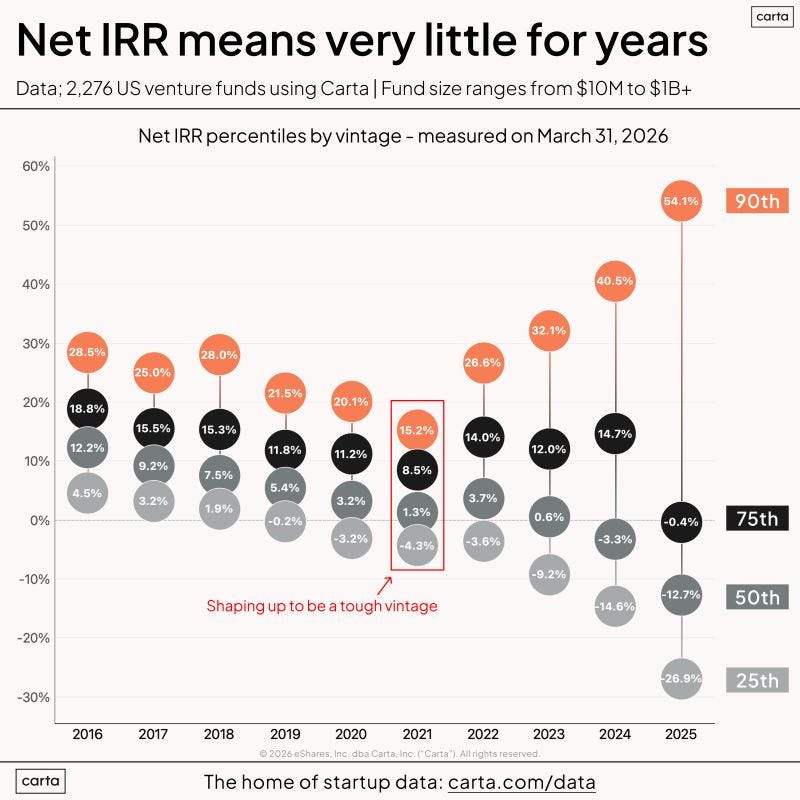
What the data shows is that IRR dispersion in early years is wild. Top quartile funds from the 2021 vintage are sitting at 15.2% net IRR. Median is 1.3%. Bottom quartile? -4.3%. None of those numbers tell you much about what those funds will ultimately return. Vintage 2021 might “shape up to be a tough one,” as Carta itself notes, but five years in, the IRR signal is mostly noise.
So in this sense, “IRR doesn’t matter” is right.
That has been the orthodox view for years. But the framing is starting to break down, and the reason matters for anyone allocating to or raising venture capital today.
An important shift
Companies are staying private longer than they used to. In the US, the data shows companies remain private roughly 10 to 12 years now vs. ~7 years a decade ago. Worth flagging that this data point isn’t directly applicable to Latam, where companies rarely go public at all. That’s not a footnote. It’s part of the problem we’ll get to.
What we should keep in mind is that funds generally promise a 10-year horizon, but we are now realistically looking at 13 to 15 years to full liquidation. The math of “wait long enough and MOIC reveals itself” works fine when the wait is 8 years. It works much worse when the wait is 13, 14, or 15 years.
In that world, IRR becomes significnatly more relevant for LPs, especially when they measure whether the wait was worth it.
Consider two funds, both returning 3x MOIC to their LPs:
Fund A returns 3x over 8 years. Net IRR: roughly 22%.
Fund B returns 3x over 14 years. Net IRR: roughly 11%.
Fund A is a strong vintage. Fund B is barely beating public market returns, and that’s before accounting for the illiquidity LPs accepted to be in the asset class. Same MOIC, fundamentally different outcomes.
Sophisticated LPs already understand this. The “IRR doesn’t matter” frame is convenient when everyone is in the early years of a fund, but it loses its appeal when an LP has been waiting 12 years. Unless, of course, you can deliver a 5, 7, or 10x fund. Under that scenario LPs are likely happy to wait and the IRR should still be able to hold up nicely.
The Latam compounding problem
This is where things get harder for Latam VCs specifically, and where the IRR conversation becomes urgent rather than academic.
Latam GPs face two compounding pressures that US GPs don’t, and they hit IRR from both directions: longer time to liquidity, and lower realized value when it finally arrives.
Reason 1: Exits are structurally scarcer
Exits in Latam are structurally scarcer than in the US. The reasons:
Strategic M&A in Latam is thin. The universe of strategic acquirers willing to pay venture-scale multiples for Latam tech is small, and growing slowly.
The IPO window for Latam companies on US exchanges has been mostly closed since 2022. Companies that would have IPOed in 2021 are sitting in the portfolio still.
The secondary market for Latam VC positions is underdeveloped. GPs can’t easily sell positions for liquidity the way US peers can through structured secondaries.
The result: even great Latam companies sit in portfolios longer than equivalent US companies. The denominator in your IRR calculation keeps growing.
Reason 2: When liquidity comes, it comes at a discount
When liquidity finally does come, it often comes at a discount that US-trained investors underestimate.
Local public markets trade Latam tech below US comps. Bovespa and BMV list Latam tech at multiples meaningfully lower than their US peers, when they list at all. Going public locally is often worse than staying private.
Strategic buyers price in country risk and FX risk. A deal that would clear at 8x revenue in the US clears at 5x for a Latam asset.
Secondary buyers demand steeper haircuts on Latam positions because the underlying liquidity options are weaker.
Put both sides together and you get the compounding effect: longer time to liquidity multiplied by smaller realized value when it comes equals an IRR significantly worse than the headline MOIC suggests.
A Latam fund that shows a 3x carrying value across its portfolio in year 7 might realistically deliver a 2.2x to 2.5x MOIC over 14 years. That’s a net IRR somewhere around 5 to 7%, before management fees and carry.
Compare that to public market returns over the same period. The premium for taking venture risk in Latam disappears.
What this means for VCs and founders
The “IRR doesn’t matter” frame works in environments where capital recycles quickly and exits clear at fair value. Latam isn’t that environment right now, and pretending otherwise is going to cause real damage when current vintages mature.
For VCs: the right questions are no longer just about portfolio quality and MOIC potential. They’re about realistic time to liquidity, expected realization discount, and what IRR math you are actually solving for. A fund that wants to defend a 3x MOIC target should be able to walk through a 10-year IRR scenario, a 14-year scenario, and an 18-year scenario. If you can’t, the next fundraise is going to be uncomfortable.
For founders: when your VC pushes you on growth, on capital efficiency, on M&A optionality, this is often the math driving them. They are not being unreasonable. They are doing the IRR calculation on a 14-year hold and trying to make it work. Understanding that math makes you a better partner to your investor, and a better operator of your own company.
All of this to say: “IRR doesn’t matter, until it does.”
In Latam, it does now. The combination of longer holds and steeper realization discounts means that fund managers who ignore IRR are setting themselves up to deliver returns that look bad relative to less risky asset classes.
The next generation of Latam funds will be defined by the GPs who internalize this. The ones who don’t will struggle to raise the next vehicle.
Great topic!